Nettsider med emneord «History of science»

Zalophus wollebaeki er en sjøløve som bare finnes ved Galápagos-øyene, rett under ekvator i Stillehavet, nesten tusen kilometer utenfor fastlandskysten av Ecuador i Sør-Amerika. Hva er grunnen til at denne sjøløven fra fjerne farvann ble oppkalt etter en norsk zoolog?

Zalophus wollebaeki is a sea lion only occurring at the Galápagos Island, just under the equator in the Pacific Ocean almost a thousand kilometre off the coast of Ecuador in South America. What was then the reason for naming the species after a Norwegian zoologist?

How to measure the metabolism of a seal, or a bird, or a human? The University of Oslo’s first zoophysiologist developed an instrument to accurately determine the content of respiratory gases.

Hidden away in a barn in Hønefoss, half an hour’s drive from Oslo, three large crates contained forgotten mementos from the University’s centennial celebrations in 1911. What was the story of these formal written greetings, ornately bound in velvet and leather, embossed with silver, gold and bronze?
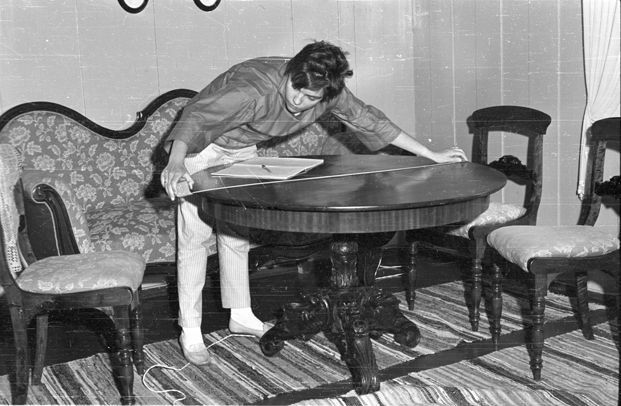
In the 1960s, the University’s Department of Ethnology initiated an ambitious project: a new national register containing information about objects that had been typical in Norwegian society through the ages.
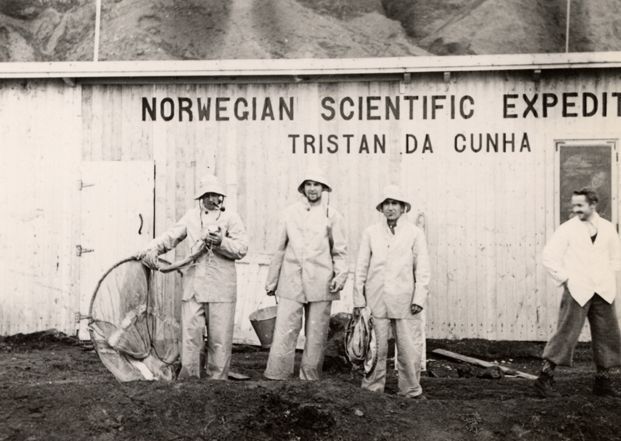
In 1937, a multidisciplinary team of scientists went ashore on Tristan da Cunha – the most remote inhabited island in the world. This Norwegian expedition would be the first thorough scientific study of this archipelago in the middle of the South Atlantic. Various disciplines were represented: geology, zoology, botany, dentistry, medicine and sociology.

Professor Christopher Hansteen is a central name in Norwegian history of science, but few people know that he introduced a special Norwegian system of measures and weights immediately after Norway’s separation from Denmark in 1814.

Ragnar Frisch started out as a silversmith, but ended up building up a university department that was worth more than gold for the politicians charged with the task of rebuilding war-torn Norway. Economics played an important role in Norwegian politics after the Second World War.
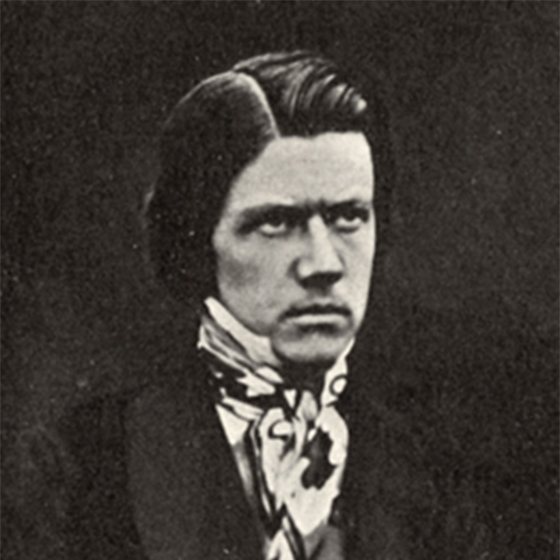
The Geological Survey of Norway (NGU) introduced the slogan “Geology for society” in 1986, but the idea that its mapping work would both strengthen geological research and be useful to society as a whole can be traced right back to its establishment in 1858.

When Norway’s first ever university was founded, it comprised four faculties, one of which was medicine. Why was medicine given such high priority, when none of the framework conditions were in place?

In the second half of the nineteenth century, teachers, vicar’s wives, farmers and doctors across Norway took part in a widespread voluntary project, run by the University’s Botanical Gardens.
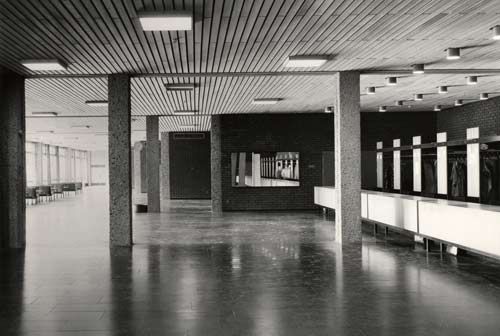
The new buildings for the Faculty of Social Sciences were completed in 1967. The Eilert Sundt buildings, A and B, and the Harriet Holter building demonstrate how Norwegian architecture evolved towards a more rustic expression over the course of the decade.
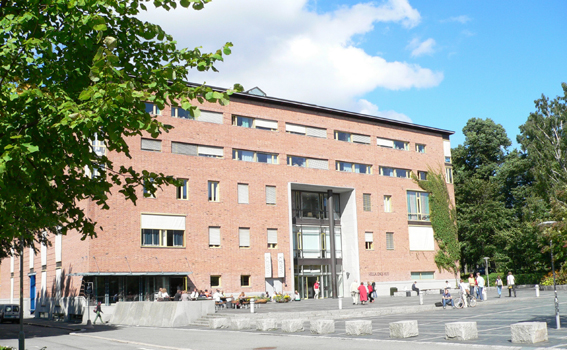
As an academic discipline, pedagogy relates to the very foundations for the reproduction and development of any society. Pedagogy, as it developed at the University of Oslo from 1938, can be regarded as a prism for cultural, social and political movements in recent Norwegian history.
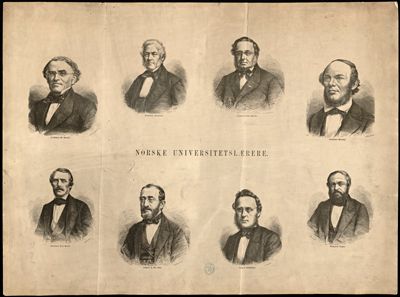
In the nineteenth century, each individual faculty had only a handful of professors. This is a register of all the academic employees at the University of Oslo from 1813 to 1984. The register provides great insight into the developments in the subjects over time, individual careers, and which individuals worked at the university at the same time, both across faculties and within individual academic communities.
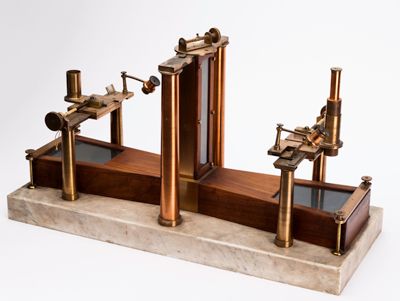
The database of University History Collections comprises collections from several academic communities at the University of Oslo.

Trygve Haavelmo, professor of economics at the University of Oslo was awarded the world’s most prestigious prize in 1989. When the outstanding researcher and lecturer was not at Blindern, often as not he would be out on his Harley-Davidson, armed with his fishing rod.

When Odd Hassel was awarded the Nobel Prize in 1969, he dominated the front pages of all the Norwegian newspapers. His death twelve years later was barely mentioned.
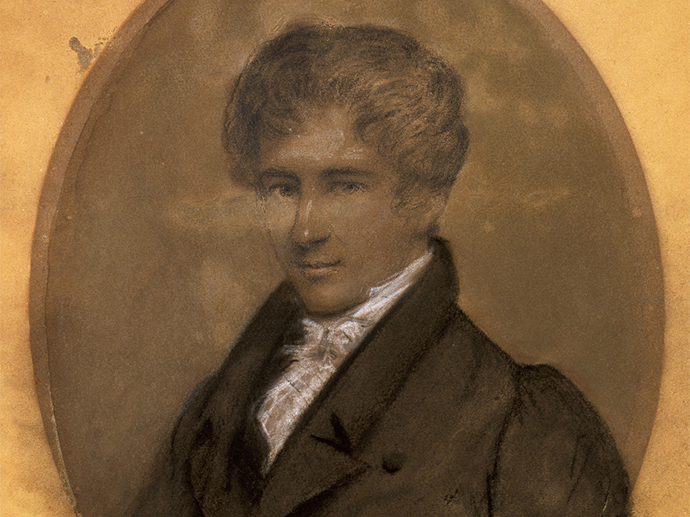
Despite only living to the age 26, he published works that have earned him a place among the world’s foremost mathematicians.
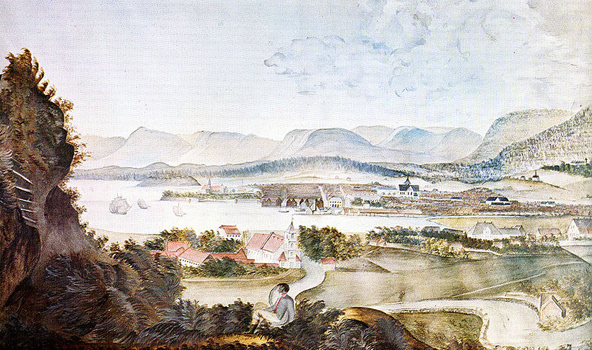
The University of Oslo was founded in 1811. However, the campaign for a separate Norwegian university started some 150 years earlier. The history of universities stretches back to the Middle Ages.
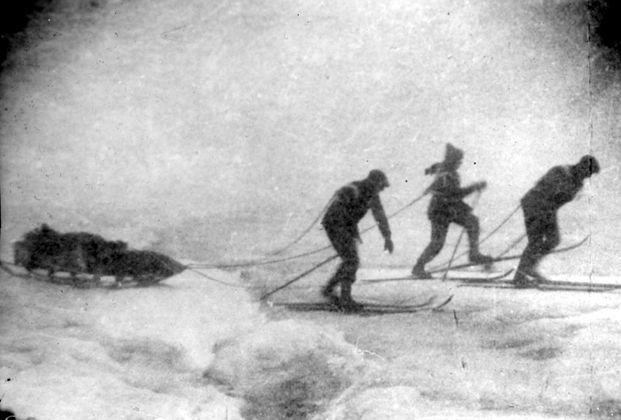
In 1919, Olaf Holtedahl, professor of geology at the University of Oslo, proposed a Norwegian multi-disciplinary scientific expedition to Novaya Zemlya.
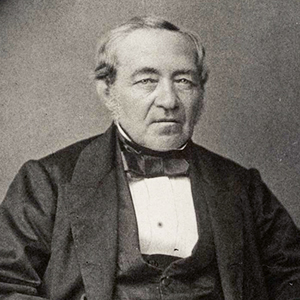
Christian Heinrich Grosch (1801–1865) designed the Observatory, the first Palm House in the Botanical Garden and the university complex on Karl Johans gate. His designs dominated public buildings in Norway for several decades after 1814.

Professor Ragnar Frisch (1895–1973) founded the Department of Economics in 1932. As a result of a number of ground-breaking works, he was awarded the Nobel Prize in Economics in 1969.

The University’s Astronomical Observatory from 1833 is one of the oldest buildings built for the University. Here Professor Hansteen worked on astronomy, surveying, time and geomagnetism. Parts of the architect Grosch’s neo-classical building were in themselves a large scientific instrument.
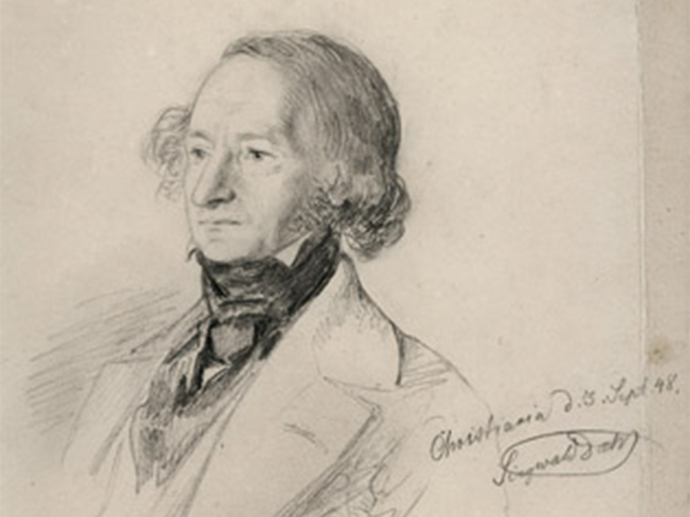
Can one professor really be expected to head the Norwegian Geographic Survey, the Meteorological Institute and the Norwegian Metrology and Accreditation Service – in addition to his day job? Norway’s first professor of astronomy had very busy days, yet still managed to fit in a field trip to Siberia.

The University of Oslo is Norway’s oldest and largest university. Until 1939, it was called the Royal Frederik University, or Universitas Regia Fredericiana in Latin. The institution was named after Frederik VI, King of Denmark-Norway, who founded the University.