Registration
The Struve Geodetic Arc represented the first accurate measuring of a long segment of a meridian. This helped to establish the exact size and shape of the planet and marked an important step in the development of earth sciences and topographic mapping. It is an extraordinary example of scientific collaboration among scientists from different countries, and of collaboration between monarchs for a scientific cause.
Among the collaboraters were Professor Christopher Hansteen of the Christiania (Oslo) Observatory. Hansteen assisted Struve for the periode of 1845-1855. Today, the Struve Arc has been inscribed in Unesco's World Heritage List.
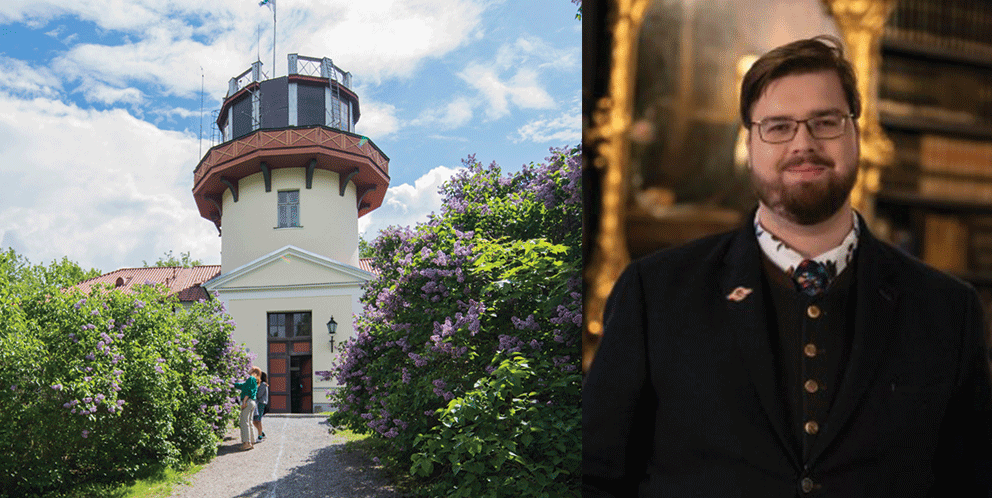
In this talk, Kaarel Nõmmela will give insight to this fascinating project, as well as to Struve himself.
Speaker info
MA Kaarel Nõmmela
Curator of Educational Activities, University of Tartu, Estonia
Kaarel has a background from archaelogy and works in the Department of Education at the University of Tartu. He is currently a member of staff at the University of Tartu Museum, teaching at Struve’s own Observatory.
Program
- Introduction: Museum manager Bjørn V. Johansen
- Evening talk: Kaarel Nõmmela
The program is free of charge. Registration is mandatory. Regrettably the Observatory is not universally accessable, but the talk will be held on the ground floor of the building. For any questions or assistance, please contact Bjørn V. Johansen before your visit: b.v.johansen@khm.uio.no.